
I had this vision of building a cob cabin in the back corner of my land. Since I had no experience with building or working with cob, I thought I would start with a small project, a welcome bench. I knew I had a lot of clay and sand in my soil and I had piles of baling twine that a previous owner had left around, but I didn’t have straw. So, I decided I would use the twine as the tensile strength and test out the earth to find the right mixture of clay and sand. I started this project in 2011, and am still working on it. I’m glad I started small.
My first step was to see what kind of earth I was working with to see if I had to make adjustments to the clay/sand ratio. I dug a small hole on my land and mixed the earth from under the topsoil with water in a jar and shook it. I let it sit and works its magic. It is supposed to separate the sand from the clay to a ration of 2 parts clay to 1 part sand. I discovered that was what I had, about 2 parts clay and 1 part sand. So I called in the big guns and hired a back hoe to dig a large hole and make some piles of this earth.


Once I got the earth I made, with the help of some friends, a pad to build upon. I removed the top soil and filled it with 3/4 inch gravel. Then I started building the foundation of the bench. I learned a few things here. I should have made the foundation much higher, as moving rocks is easier than mixing soooooo much cob. I also ended up making it too narrow to begin with so I had to add a layer later on.


I also started making test bricks, because that’s what was suggested. I am not sure how well I used this process because I didn’t really listen to what the test bricks were telling me, I just went with what I wanted to be true: my earth was the right mixture of clay to sand. Having worked with it over the past 7 years, yes, 7 years, I am wondering if I should have spent more time on this phase, really understanding the cob mixture and refining it. I used The Cob Builder’s Handbook by Becky Bee which I got off of Amazon to do this part. The sticks in the cob are to show the shrinkage and used to write the ratio of sand to clay to straw or in my case, baling twine.


After I discovered what I wanted to see, talk about confirmation bias, I started the process of mixing cob. Being a single person who was going to do majority of the work I decided to buy an old metal cement mixing machine, which only worked for a bit and ended up not putting enough pressure on the mixture to bind the clay and sand fully. So, I did a lot of foot stomping and squishing. I learned that I did not put in enough baling twine, it didn’t fall apart or anything, but more tensile strength would have been better. I had cut the twine into about 4-6 inch bits and mixed it up. I also learned that if I separated the twine into a thinner threads it probably would have worked better.


And so the process began, stomping and applying cob . . .


At this point I started making bottle bricks out of old bottles. I use nail polish remover, some yarn, a lighter and a sink full of water to break the bottles, then I wrapped them in tinfoil for maximum reflection and taped them together. I did not take into consideration may different factors, the fact that I was going to add to the back of my bench, the fact that adding plaster is about an inch and the weight of the cob pressing on the bottles. So, the bottles are sunk in in the front, carved out in the back, and bulging a little in places. I had help on the day that it was time to install the bottles and I was unable to adequately share my vision, so the bench aesthetic morphed again. The intention was to have a sun like design in the centre to add some male energy and balance the female posts, whom I affectionately call ‘my ladies’. Alas, live and learn.


Then I stomped and cobbed some more . . .


It lasted over 3 summers and sat tarped over 3 winters. Every year I’d take the tarp off and find all the ways that nature was trying to destroy my creation. I’ve learned a little about how the laws of the universe are in fact working against this creation, but not enough to create a change and not enough to stop this crazy endeavour.
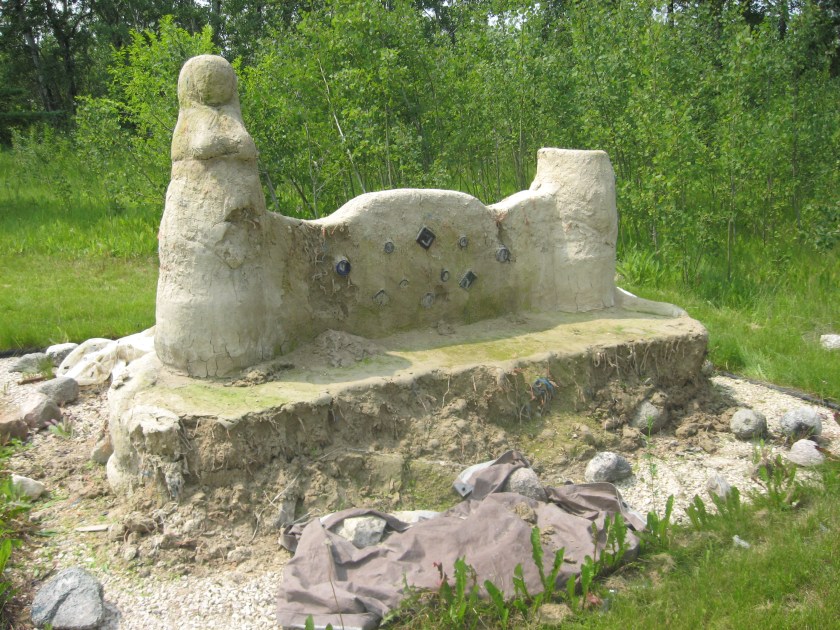
Then I started trying to figure out how to plaster it. In the meantime I was also trying to get a living roof built over it. I kept meeting dead ends at every turn. I tried to see if it was something I could do, but with no background knowledge in carpentry and no idea how to do it, I was at a loss. I kept asking. I asked one fella who said he would, bought the wood, accepted payment, but never was able to follow through, left the wood, returned the payment and I looked for someone new. Others I spoke to, but none committed and still today it is standing roofless, tarped for the winter, hoping to be plastered and covered next spring. The first plaster experiment was with natural plaster made from clay, sand and horse manure. It was fun to make, but just cracked and crumbled after it dried.


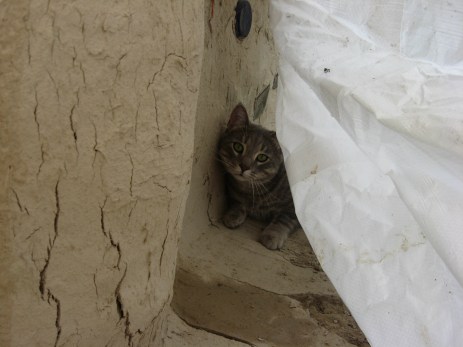
My cat playing in the tarp with the flaking earthen horse manure plaster
I tried several different earthen plaster mixes, but did not discover one that worked. The following summer I used lime plaster. Now, using lime plaster is a bit of an art, and one that I have not mastered, in fact, I’ve hardly even apprenticed at it. The first coat of lime plaster dried too fast and cracked every where. The second one did the same. I started learning how to regulate the temperature and eventually, with the help of my dad, finished plastering the bench with lime that was fairly solid.


Then I decided to leave it un-tarped for the winter and leave it under a fabric gazebo. The problem with that was that the roof was not quite big enough and there were very large grommet holes in it which funnelled the rain and snow melt directly into the seat of the bench. This eroded the lime and seeped under it destroying the plaster job. Which is how I found the bench this spring. Oh, and the fabric could not withstand the sun and wind damage and tore apart.


Over this summer, 2018, I stomped some more cob, filled the cracks, extend the bench in a few places and forgot to take an after shot. I wanted to plaster it one last time, but we had an amazingly hot summer which is not good for lime plaster as it increases the likelihood of it cracking. Then I was going to do it in the fall, but we had this crazy bizarre fall with snow in September and record breaking rains. So, it is tucked in again for another winter and hopefully I can get my living roof built by some of the builders who will be working on my house. Here’s hoping.


I have certainly learned a lot through this process and will take some time to reflect, in another post, on the physical as well as spiritual lesson this process has taught me . . . and some I have yet to learn.
 Cultivation Peace